wtorek, 23 września 2014

Mozambique Drill

W poście opisującym "sztuczkę z pierścionkiem" w reżyserskiej wersji "Leona Zawodowca" wspomniałem o technice, którą stosował tytułowy bohater dokonując zleconych egzekucji (oczywiście wg zasady "żadnych kobiet i dzieci"). Przypomnijmy: były to dwa strzały w korpus - pierwszy w brzuch - obezwładniający cel/przeciwnika oraz drugi w płuco lub serce - wykańczający. Nic innego jak tzw. "double-tap", o którego zasadności, choć w nieco innym układzie, wspomina główny bohater filmu "Zombieland" (2009). Choć akurat w przypadku żywych trupów tak naprawdę możemy mówić jedynie o strzale w głowę, a konkretnie - strzale "wyłączającym" zainfekowany mózg. I tu wystarczy w zupełności jedna kula, chyba, że pierwsza z dwóch - wystrzelona w korpus, na spowolnić wygłodniałego żywego trupa.

In the post describingthe ring trick” in „Leon the Professional: Director’s Cut”, I mentioned a technique that was used by the title character while killing his targets (of course, according to the rule: „no women, no kids”). Let me remind you what it was: two shots in the torso – the first on in the abdomen – disarming the target, the secondo in the lungs or heart – the finishing one. Nothing, but a classical „double tap”, described as a quite reasonable, but in a slightly different way by the main protagonist of „Zombieland” (2009). Although in case of the living dead, we can talk about only about a headshot that turns off the infected brain. And here one shot finishes the job unless you want the first of two bullets, fired in the torso, to slow down a flesh-starving living dead.


Dzisiaj jednak zajmiemy się nieco techniką, którą można dostrzec u trzech bardzo wyrazistych bohaterów filmów Michaela Manna: Franku – tyłowej postaci z filmu "Złodziej" (Thief, 1981), Neilu McCauley'u z "Gorączki" (Heat, 1994) i Vincencie z "Zakładnika" (Collateral, 2005).

Today however, we shall look at a different technique that can be noticed in case of three very powerful characters from Michael Mann’s movies: Frank - the title character of „Thief” (1981), Neil McCauley from „Heat” (1994) and Vincent from „Collateral” (2005).


Technika to tzw. "Mozambique Drill" (lub też „Failure Drill”) i polega na oddaniu szybkich dwóch strzałów w korpus w celu spowolnienia i obezwładnienia celu, a następnie strzału ostatecznego w głowę. Sprawdza się na niewielkich odległościach czy w walce w pomieszczeniach (CQB), w szczególności w przypadku przeciwnika noszącego osłony na korpusie lub będącego pod wpływem środków odurzających, które sprawiają, że nie odczuwa on bólu wynikającego z odniesionych obrażeń. 

The technique is the so called „Mozambique Drill” (or „Failure Drill”) and is based on two fast shots in the torso that slow down and disarms the target, and the final shot in the head. It’s reliable in case of short distances or close quarters battle (CQB), especially if the target is protected with armor (bullet-proof vests) or is intoxicated so he/she does not feel pain caused by gunshot wounds. 


Technika powstała w czasie wojny o niepodległość Mozambiku, kiedy to żołnierz Korpusu Piechoty Morskiej Stanów Zjednoczonych, Mike Rousseau, brał udział w walkach o lotnisko w Lourenço Marques (obecnie Maputo). Zaatakowany przez bojownika Frontu Wyzwolenia Mozambiku, oddał w jego kierunku dwa strzały - typowy "double-tap", trafiając po obydwu stronach mostka. Zwykle, to powinno wystarczyć, by zatrzymać przeciwnika, lecz okazało się, że rebeliant nadal atakował (nie miał kamizelki kuloodpornej – zawdzięczał to prochom, którymi był nafaszerowany). Konieczny był trzeci strzał - w głowę. Rousseau opowiedział o wydarzeniu swojemu znajomemu, Jeffowi Cooperowi, również żołnierzowi Korpusu, który określił technikę jako "triple-tap" czy inaczej "Mozambique Drill" i wprowadził ją do technik praktycznego strzelania, dziś już powszechnie stosowaną.

The technique was invented during the Mozambique War of Independence, when a USMC soldier, Mike Rousseau, was taking part in the battle of Lourenco Marques air port (presently: Maputo). Attacked by a freedom-fighter of The Mozambique Liberation Front, he returned fire with two shots – a classical „double tap” and hit him on the both sides of the sternum. Usually, it is enough to stop the targe, but the freedom-fighter was still advancing (he was not wearing any armor – his condition was based on drugs). The third shot – in the head, was necessary. Rousseau described the incident to his friend, Jeff Cooper, also a Marine, who called the technique as „triple-tap” or „Mozambique grill” and introduced it as one of the practical shooting techniques, presently widely in use.


Pierwszy raz w filmach Manna, "Mozambique Drill" pojawia się w "Złodzieju", gdy Frank mści się na swoich mocodawcach - trzy kule posyła w klatkę i głowę Leo (Robert Protsky), który nie potrafił przyjąć do wiadomości, że Frank nie chce więcej robić dla niego skoków. Tytułowy złodziej używa tu pistoletu M1911A1 kal. .45 ACP, który zmodyfikował dla niego rusznikarz Jim Hoag (modyfikacja polegała m.in. na wydłużeniu lufy, choć w scenach zobaczymy jednocześnie standardową wersję na zmianę z wersją "custom").

For the first time in Mann’s movies we can see „Mozambique Drill” in „Thief” when Frank takes vengance on his employers – three bullets are fired in the chest and head of Leo (Robert Protsky) who could not accept the fact that Frank didn’t want to work for him anymore. The title character uses here a .45 ACP M1911A1 pistol, modified by a gunsmith, Jim Hoag (the modification incluced e.g. the lenghtening of the barrel, although in the scenes we will see the standard and the custom version interchangeably).


"Failure Drill" stosuje Neil McCauley dokonując egzekucji (za pomocą pistoletu .45 ACP SIG-Sauer P220) na dawnym wspólniku, Waingro (Kevin Gage), który zaczął sypać policji.

„Failure Drill” is used by Neil McCauley to finish (with a .45 ACP SIG-Sauer P220 pistol) his former partner, Waingro (Kevin Gage), who became a police informant.


Wcześniej, w scenie otwierającej film, jeden z jego ludzi - Michael Cheritto (Tom Sizemore), w ten sposób zlikwidował jednego z trzech strażników z furgonetki bankowej (de facto zabicie całej trójki wymusił Waingro) - tym razem w użyciu jest karabinek szturmowy w wersji spadochroniarskiej FN FAL 50.61 kal. 7.62x51mm (uzasadnieniem użycia techniki były możliwe kamizelki pod mundurami ochroniarzy).

Earlier, in the opening scene, one of his men – Michael Cheritto (Tom Sizemore) killed in the same way of the guards from the armored van (in fact, the action of killing all three guards was initiated by Waingro) – this time it is a 7.62x51mm FN FAL 50.61 assault rifle in a version for paratroopers (the technique was used because of the armor under the guards’ vests).


Mistrzem w "Mozambique Drill" i generalnie w posługiwaniu się bronią jest jednak Vincent, grany przez Toma Cruisa płatny zabójca, były wojskowy, który "wynajmuje" sobie Bogu ducha winnego taksiarza Maxa (Jamie Foxx) do zawiezienia go w kilka miesc w L.A., gdzie ma zlikwidować cele - świadków koronnych w procesie latynoskiego gangstera. Bronią Vincenta jest Heckler & Koch USP45, kalibru .45 ACP.  Jego umiejętności są widoczne w kilku scenach, jednak najbardziej widowiskowa jest scena spotkania z bandziorami w małej bocznej uliczce. W ciągu ułamków sekund Vincent oddaje pięć strzałów - dwa w najbliżej stojącego przeciwnika w jego tors, trzy w drugiego: dwa w korpus, jeden w głowę. Po czym wykańcza pojedynczą kulą w głowę pierwszego.

A master of „Mozambique Drill” and in weapon-handling in general is Vincent, an assassin, played by Tom Cruise, an ex-military who hires an innocent cab-driver, Max (Jamie Foxx) to drive him around L.A. and take him where he has his job to do – crown wintesses in a trail of a Latino gangster. Vincent’s weapon of choice is a .45 ACP Heckler & Koch USP45. His skills are visible in several scenes, but the most spectacular is the one with punks in a small alley. In a split secondo, Vincent fires five rounds – two in the torso of the nearest target, three in the second one: two in the torso, on ein the head. Then he finishes the deal with the first guy with a single bullet in the head.


Mix technik "double-" i "triple-tap" widzimy zaś w scenie w dyskotece "Fever", gdzie liczba strzałów zależy od liczby celów i zagrożenia. Z kulami w klatce piersiowej i w głowie kończy jeden ze świadków koronnych, których zlikwidować ma Vincent. w tym wypadku jego cel otrzymuje nawet 3 strzały w klatkę – po oddaniu pierwszego Vincent orientuje się, że skończyła mu się amunicja, wymienia więc szybko magazynek i oddaje – jak automat – kolejne dwa, a dopiero potem trzeci, a tak de facto – czwarty – w głowę). W ten sam sposób zabija Detektywa Fanninga, który jako jedyny zorientował się w sytuacji między Maxem a Vincentem.

A mixture of „double-” and „triple-tap” is presented in the „Fever” club scene where the number of shots fired depends on the number of active targets and the threat. With bullets in his chest and head ends one of the crown witnesses that Vincet is supposed to finish off. In that case, the target gets even three shots in the torso – having fired the first one, Vincent realizes he is out of ammo, so he changes the mag fast and fires – in an auto-mode, another two, and then the third one or to be specific – the fourth one in total, in the head. That’s also the way he kills Detective Fanning (Mark Ruffalo), who is the only one who actually knows the relation between Max and Vincent.


Co ciekawe, we wszystkich trzech filmach zobaczymy, równie charakterystyczne dla postaci Manna, sprawdzanie komory (tzw. "brass-check"): czy znajduje się w niej nabój. 

What is interesting, in all three movies we will see the so called brass-check, also characteristic for protagonistist and antagonists in Mann’s movies. 

Sprawdzenie naboju w komorze / Brass-check / via: imfdb.org

"Złodziej", "Gorączka", "Zakładnik" - obrazy te, będące dla mnie majstersztykami pod każdym względem, świadczą również o tym, jak doskonale aktorzy są przygotowywani do ról, w które się wcielają. Zresztą, Michael Mann słynie z tego, że aktorów przygotowuje doskonale pod kątem umiejętności, jakie - wg scenariusza, posiadają kreowane przez nich postaci. James Caan przeszedł w American Pistol Institute (założonym przez Jeffa Coopera - tego samego, który wprowadził "Mozambique Drill" do technik strzeleckich) szkolenie, dzięki któremu opanował m.in. sztukę wchodzenia i przeszukiwania pomieszczeń z bronią czy szybkiego przeładowywania.  Bohaterowie "Gorączki" szkolili się pod okiem byłego żołnierza brytyjskiego SAS. Tom Cruise zaś miał okazję pierwszy raz w życiu strzelać ostrą amunicją w trakcie przygotowań do "Zakładnika", a wszystko, co zobaczymy w jego wykonaniu na ekranie nauczyli go Mick Gould (takżę operator SAS) i Chic Daniel (z oddziałów SWAT policji w L.A).

„Thief”, „Heat”, „Collateral” – for me, these movies are masterpieces in all terms, they also proove that the actors are very well prepared to play their characters. In general, Michael Mann is famous for that he wants his actors to be trained for the role in terms of skills that their protagonist/antagonist has according to the script. James Caan was trained in the American Pistol Institute (founded by Jeff Cooper - the guy who introduced "Mozambique Drill" to shooting techniques) where he learnt, among others, room clearing techniques and speed-reloading. Character in "Heat" were supervised during the training by a British ex-SAS operator. Tom Cruise had an opportunity to fire live ammo during the preparations for "Collateral" and everything we can see him do on the screen is a result of what Mick Gould (another SAS operator) and Chic Daniel (from LAPD SWAT) taught him.


Filmy Manna mają też to do siebie, że pełno w nich wzajemnych odniesień i wspólnych motywów, jak miasto jako bohater w tle, czy elementów "Mozambique Drill" czy "brass-check". Ale to już temat na osobny wpis. Biorąc pod uwagę to, że jestem fanem filmów tego reżysera, możecie się go spodziewać całkiem szybko.
Mann's films are full of mutual references and common motifs, such as the city in the background as one of the characters or elements like "Mozambique Drill" or "brass-check". This, however, will be discussed one day in a separate post. Considering the fact that I'm a fan of this particular director and his movie, you can see this post coming preety soon.

środa, 10 września 2014

Sin City 2: giwery warte strzału / Sin City 2: the guns to shoot with

To nie będzie typowa recenzja. Nie mam zamiaru oceniać "Damulki wartej grzechu" w odniesieniu do komiksowej twórczości Franka Millera ani porównywać go do pierwszej części z 2005 roku. Powiem tylko, że z kina wyszedłem usatysfakcjonowany, mając poczucie, że pieniądze na bilet nie poszły w błoto. Przyznaję, nie było fajerwerków, bo trudno przeskoczyć innowacyjne podejście "jedynki" (to samo było z „Matrixem” czy „Jurassic Park”). W każdym razie, dostałem to, po co przyszedłem.

That won’t be a regular review. I am not going to rate "A Dame to Kill for" in relation to Frank Miller’s comic book or compare it with the first part made in 2005. I’m just gonna say that I left the cinema satisfied with a feeling that the money I spent on the ticket didn’t go down the drain. I admit, there were no fireworks, but it’s hard to make something more innovative than "number one" (the same thing we had with „Matrix” or „Jurassic Park”). Anyway, I got what I came for.


Oglądając film, oglądam go bowiem na dwa sposoby. Jako zwykły widz. I jako pasjonat broni palnej w filmach (stąd wziął się przecież fanpage, a potem ten blog). I ten drugi sposób dominuje. Zwracam uwagę na to, z czego strzelają i jak strzelają. I tak było i teraz, zwłaszcza, że bohaterowie "Sin City", czy to pierwszej części czy jej sequela/prequela (trudno powiedzieć, czym tak naprawdę jest dwójka – być może jednym i drugim: w zależności od historii) potrafią zrobić użytek z broni palnej (i nie tylko – vide: Miho) i niezłą rozwałkę.

When I am watching a movie, I am watching it in two ways. As a regular cinema-goer. And as a movie-gun-lover (that’s where the fanpage and the blog came from). And the latter dominates. I pay attention to what the characters are shooting with and how. And that’s how it was this time, especially because the protagonists and antagonists of "Sin City", both the first part and its sequel/prequel (it’s hard to tell what the second part really is – perhaps it is both, depending on the story) can surely use firearms (and other arms too – vide: Miho) to make a huge mess.


Uwaga! Tekst zawiera spoilery! / Warning! The text contains spoilers!

Co zwraca uwagę w dwójce? Przede wszystkim Nancy Callahan (Jessica Alba) z rewolwerem nieżyjącego Johna Hartigana. Smith & Wesson Model 29 kaliber .44 Magnum. Callahan – tak samo miał na nazwisko Brudny Harry. I to jest jego spluwa. Jak dla mnie: piękne nawiązanie do klasyki. Dla przypomnienia – w pierwszej części mogliśmy zobaczyć Nancy również z rewolwerem, a dokładnie – z dwoma Ruger Blackhawk kalibru .357 Magnum. Zmiana wyszła na dobre – Nancy, jak na spadkobierczynię wielkiego nazwiska przystało, robi dobry użytek z rewolweru kalibru .44 Magnum.

What catches one’s attention in the second part? First of all, it is Nancy Callahan (Jessica Alba) with a revover that used to belong to deceased John Hartigan. The .44 Magnum Smith & Wesson Model 29. Callahan – that’s the name of Dirty Harry. And that was his piece. For me: it is a brilliant reference to the classic. Just to remind you – in the first part, we could see Nancy also with a revolver or to be precise: with two .357 Magnum Ruger Blackhawks. The change was for better – Nancy, as benefits a heir of the great name, makes a helluva use of the .44 Magnum handgun.


Rewolwery to specjalność „damulek wartych grzechu” - o ten tytuł mogą rywalizować tak de facto Nancy Callahan i Ava Lord (Eva Green). Ta druga, jak na femme fatal przystało, nosi mały rewolwer, typową .38, która może się zmieścić w torebce, a konkretnie Charter Arms Undercover. Broń mogliśmy zobaczyć na słynnym plakacie, który tak zbulwersował Amerykanów.

Revolvers is a specialty of „dames to kill for” – and actually two: Nancy Callahan and Ava Lord (Eva Green) can fight over the title. The latter, as benefits a femme fatal, carries a small revolver, a typical .38 that can be put in a purse – the Charter Arms Undercover, to be specific. We could see the firearm in the (in)famous poster that made the Americans so sick.


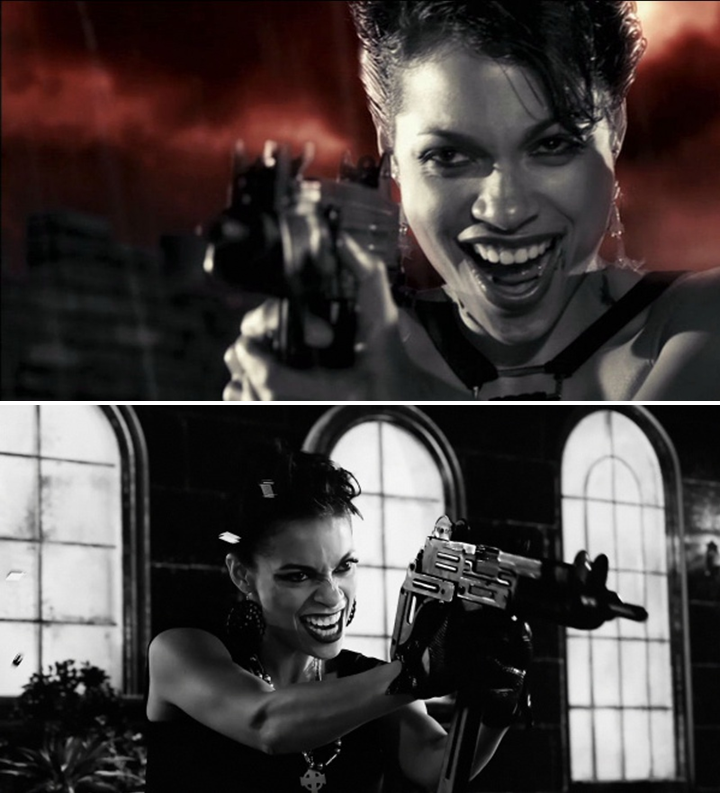
Pozostając w temacie uzbrojonych dam... Gail (Rosario Dawson) – absolutnie, bezapelacyjnie najlepiej wymiatająca z Uzi laska w historii kina – udowodniła to w pierwszej części, gdy razem z Dwightem (wówczas: Clivem Owenem - obecnie gra go Josh Brolin) grzała w bandę oprychów z Manutem (wówczas granym przez nieżyjącego już niestety Michaela C. Duncana, którego zastąpił Dennis Haysbert) na czele. Zdolności strzeleckie i miłość do tego pistoletu maszynowego potwierdziła też w "Damulce..." Generalnie, Uzi jest to całkiem sporo, także w wersji Micro. Choć jednocześnie izraelska broń okazuje się zawieść Marva w finale, zacinając się w najmniej odpowiedniej chwili.

Talking about armed ladies… Gail (Rosario Dawson) – absolutely anad irrevocably the best Uzi-shooting chick in the movie history – he proved it in the first part, where together with Dwight (back then: player by Clive Owen, now: Josh Brolin) he wasted a band of punks led by Manute (back then: played by a unfortunatelly deceased Michael C. Duncan and replaced by Dennis Haysbert). She confirmed her shooting skills and love towards the submachine gun in „The Dame...”. Generally, we will see a lot of Uzi’s here. Although at the same time, the Israeli-made firearm turns out to disappoint Marv in the finale as it jams in the worst possible moment ever.


No właśnie. Marv (Mickey Rourke). Jeśli ten gość będzie kiedyś pisał list do Świętego Mikołaja, zaproponuję mu groupona. Jego „Looks like Christmas” na widok strzelb Franchi SPAS-12 w rękach zadymiarzy na motorach pokazuje, że facet wie, co to dobra broń. A jest na tyle potężny, że może używać dwóch strzelb jednocześnie, waląc z nich jednorącz, bez potrzeby ręcznego przeładowywania. Wcześniej na ekranie mogliśmy zobaczyć coś takiego w wykonaniu Arnolda jako Terminatora szturmującego posterunek policji (zgodnie z tym, co powiedział sprzedawca ze sklepu, w którym T-800 się uzbroił: „ładowany ręcznie lub automatycznie”).

Speak of the Devil. Marv (Mickey Rourke). If this guy ever writes a letter to Santa Claus, I will suggest him collective buying. His one-liner „Looks like Christmas” when he sees Franchi SPAS-12 shotguns in the hands of motorbike troublemakers show that he knows what a good gun is. And he is strong enought to carry two shotguns at the same time, shooting them with one hand, without the need of pumping the next shell manually. Earlier in the screen we could see that done by Arnold as the Terminator storming a police stadion (according to what the clerk in the gun store, where T-800 was arming himself: „you can go pump or auto").


Rozczarowania? Senator Roark. Nie chodzi o postać, bo bydle idealnie zagrał Powers Boothe. I tu nie mam żadnych „ale”. Zabrakło mi charakterystycznej dla niego broni. Coś, z czym nigdy by się nie rozstawał, co dodawałoby mu wyrazistości, wyróżniało. W filmie widzimy go z Glockiem i Waltherem PPK, żaden z nich nie jest JEGO klamką. Ale ciekawostką jest fakt, że w obydwu filmach w pojawia się „czterdziestka piątka”, jedna z najbardziej amerykańskich broni palnych, czyli M1911A1, w wersji z tłumikiem. W „jedynce” – w rękach zabójcy granego przez Josha Hartnetta, w „dwójce” – w scenie z Rayem Liottą w epizodycznej roli biznesmena planującego szybkie zakończenie romansu z pewną prostytutką. 

Disappointments? Senator Roark. Not the character, because Power Boothe player him perfect. And here I don’t have any „but”. However, I missed a characteristic gun of his. Something he would never move anywhere without, something that would underline his image, distinguish him more. In the movie we could see him with a Glock and a Walther PPK pistol and none of these is HIS piece. But what is interesting is the fact that in both movies appears the "forty-five", one of the most American firearms, that is: the M1911A1, in a sound-suppressed version. In the first "Sin City" - in the hands of the assassin played by Josh Hartnett, in the following part - in the scene with Ray Liotta in a small role of a businessman that plans to finish his love affair with a hooker. 


Z tym samym pistoletem (bez tłumika) pierwszy raz widzimy Gail (w czerwonym płaszczu i masce) witającą w Old Town Marva z rannym Dwightem. W pierwszej części, McCarthy używał właśnie dwóch identycznych pistoletów (w "dwójce" musi sobie radzić z jedną sztuką). No i Manute nie ma szczęścia z tym pistoletem - w obydwu Sin City zalicza kulki z czterdziestki-piątki – w pierwszej części zgarnia grad pocisków .45 ACP m.in. od Dwighta, gdy dziewczyny z Old Town rozprawiają się nieproszonymi gośćmi, a w "Damulce..." kilka kulek sprzedaje mu Ava Lord.

The same pistol (without the silencer) is carried by Gail (wearing a red coat and a mask) greeting Marv and wounded Dwight in the Old Town. In the first part, McCarthy used the guns of the same model (here he has to carry on with one). And Manute has a serious problem with the piece - in both Sin City movies he takes bullets from the "forty-five" - in the first one he takes a volley of fire including .45 ACPs from Dwight when the Old Town girls get rid of the uninvited guests, and in "A Dame..." - he takes the lead from Ava Lord.


Jak na film o mieście pełnym grzechów, może zaskakiwać brak „kałasza” (w pierwszej części również), ale za to zobaczymy tu Dwighta z „najbardziej popularną pukawką w amerykańskim światku przestępczym” (jak określił to Samuel L. Jackson w „Jackie Brown”), czyli Intratec TEC-9, z której wymiatała także jedna z prostytutek z scenie strzelaniny z Manutem w pierwszej części.

For a movie about a city full us sins, a lack of the „kalash” can be suprising (in the first part too), but we will see Dwight with „the most popular gun in the American crime” (as stated by Samuel L. Jackson in „Jackie Brown”), that is: the Intratec TEC-9, used wildly by one of the prostitutes in the shootout scene with Manute in the first part.


Zdecydowanie czekam na DVD, bo o broni co nieco można jeszcze napisać. Dlatego spodziewajcie się rozwinięcia tego posta – o detalach, których nie jestem na sto procent pewien nie piszę.

I am definitely waiting for the DVD, because I can still write a bit more about guns. That’s why you can expect I will develop this post one day – I won’t write about details I am not 100% sure of.

piątek, 1 sierpnia 2014

01.08.1944-01.08.2014


* * * 

Pierwszy sierpnia cztery-cztery, wybija siedemnasta,
padają strzały w różnych częściach miasta.
Godzina W - jak walka, jak wolność, jak Warszawa,
rozpoczyna się o Polskę bitwa krwawa,
o każdy dom, każdy pokój, podwórko i plac:
sześćdziesiąt trzy dni - to odwagi był czas!
Czas honoru, walki, śmierci i poświęceń,
by Polski nie zobaczyć w niewoli już więcej.
Nie oceniaj ich, czy było warto i po co ginęli!
Nie ty szedłeś w sierpniowe dni z VIS-em w kieszeni!
Zamiast tego oddaj hołd bohaterom tamtych dni,
bo walczyli za ciebie, byś w wolnej Polsce mógł żyć!


* * * 

Na gniazda kaemów z VIS-em i granatem,
na „panterę” i „tygrysa” ze zrzutowym PIAT-em,
z butelką benzyny na transportery piechoty-
-dziewczyny i chłopaki z Pragi, Woli, Ochoty.
Bronią barykad, prując z peemów w kable „goliata”,
nie powiewa już nad stolicą hitlerowska szmata!
I choć „krowy” gonią ich do piwnic i bram,
a z nieba leci ze „stukasów” mordercza stal,
i choć to niebo dymami pożogi zasnute,
i nie widać nigdzie Liberatorów ze zrzutem,
dzieci, młodzież, dorośli z opaską biało-czerwoną,
z orzełkiem na piersi – z orzełkiem z koroną,
Warszawiacy-Powstańcy, morowi żołnierze,
w zdobycznych panterkach i oficerkach rycerze,
o wolną Polskę walczą z hitlerowskim terrorem 
z bronią w ręku, z odwagą w sercu, z honorem!


wtorek, 22 lipca 2014

Sztuczka z pierścionkiem / The ring trick

Wersje reżyserskie, czyli wszystko, co twórca chciał przekazać widzowi, ale niekoniecznie w wersji kinowej czy w pierwszym wydaniu na VHS/CD/DVD. Czasem są to niewiele znaczące sceny, które usunięto, bo nic nie wnosiły do fabuły, a spowalniały niepotrzebnie tempo. Niekiedy, tak jak w przypadku "Godziny zemsty" (1999) Briana Helgelanda, otrzymujemy zupełnie inny film (polecam obejrzenie obydwu). Najczęściej jednak "wersja reżyserska" zawiera sceny, które z perspektywy widza wzbogacają relacje głównych bohaterów, wyjaśniają pewne wątki, odsłaniają kulisy wydarzeń, nadają nowe znaczenie. Tak też jest w przypadku wersji reżyserskiej "Leona Zawodowca" (1994) Luca Bessona. 


Director’s cut, that is: all the author of the movie wanted to tell the viewer, but not necessarily in the cinema or in the first VHS/CD/DVD relase. Sometimes these are not really meaningful scenes, that were deleted, because they did not develop the plot and only slowed down the pace of the action. Sometimes, as in case of Brian Helgeland’s „Payback” (1999), what we get is an entirely different movie (I recommend watching both). Most often, a „director’s cut” includes scenes that, from a viewer’s perspective, enrich relations between main characters, explain the plot, take us behind the scenes of certain events or give a new meaning. And that’s the story with Luc Besson’s „Leon the Professional: Directors’ Cut” (1994).  


Jak "Leon Zawodowiec" się kończy, wiedzą chyba wszyscy. [Kto jeszcze filmu nie widział - niech nie czyta dalej - tekst może się okazać spoilerem, więc wróćcie do niego obejrzawszy najpierw film.] Leonowi prawie udaje się wymknąć z policyjnej obławy. Prawie, do dopada go i rani śmiertelnie narkotyczny Norman Stansfield. Obaj giną chwilę później w eksplozji - Leon odbezpiecza jeden z granatów, które znajdują się na jego policyjnej kamizelce i wręcza gliniarzowi zawleczkę ze słowami "To od Matyldy". Na ucieczkę nie ma czasu…

How „Leon” ends, everyone knows, I guess. [Who hasn’t seen the movie – please, don’t read the post – it might turn out to be a spoiler, so come back after having seen the film.] Leon almost managers to escape the police chase. Almost, because he gets hunter down and lethally wounded by a drug-addict cop Norman Stansfield. They both die in an explosion – Leon arms one of the grenades strapped to his police vest and gives the pin to the cop with the words „This is from Mathilda”. There is no time to escape...


I właśnie ta scenę, w której Leon wręcza Stansfieldowi zawleczkę od granatu, ogląda się zupełnie inaczej mając za sobą wersję reżyserską. W rozszerzonym Leonie dodatkowych scen jest kilka. Należą do nich m.in. fragmenty poświęcone treningowi dziewczynki, która pragnie być, tak jak Leon, "sprzątaczem". W standardowej wersji nauka Matyldy jest przedstawiona skrótowo: dziewczynka "zdejmuje" polityka uprawiającego jogging w parku, trafiając go z karabinu na kule z farbą. Kolejne sceny zaś ukazują po prostu codzienne życie dwójki bohaterów: sprzątanie, posiłki z obowiązkową szklanką mleka, czyszczenie i obsługę broni, gimnastykę.


And exactly the scene, where Leon hands in a pin to Stansfield, is perceived in a different way if we have seen the director’s cut. In the extended „Leon”, there are several additional scenes. These include fragments devoted to training of the girl who also wanted to be a „cleaner” just like Leon. In the standard version of the movie, Mathilda’s education is shortened: the girl takes down a politician who jogs in a park, hitting him with a bullet with paint. Following scenes show us just an everyday life of the two protagonists: washing, meals with an obligatory glass of milk, cleaning and handling of the firearms, gymnastics.


Natomiast w wersji reżyserskiej zobaczymy nieco więcej i dzięki tym właśnie scenom robi się znacznie ciekawiej. Leon pokazuje Matyldzie, jak likwidować cele, czyli w skrócie: jak i gdzie strzelać, by zabić. Płatny zabójca wybiera jako "obiekt treningowy" dealera narkotykowego. Po sprawdzeniu mieszkania (z Berettą 92FS z tłumikiem i rewolwerem Smith & Wesson Model 586), Leon instruuje Matyldę, iż należy oddać dwa strzały: pierwszy obezwładniający w brzuch, drugi w klatkę piersiową - serce lub płuco, by ostatecznie zlikwidować cel - nigdy w twarz, by można było potwierdzić wykonanie zlecenia. Matylda, jak w przypadku treningu snajperskiego, używa kul z farbą, tym razem wystrzelonych z "czterdziestki-piątki" typu M1911 - również z tłumikiem.


Meanwhile, in the director’s cut, we shall see a little more and thanks to those scenes, it’s really getting a lot more interesting. Leon shows Mathilda, how to take targets down, or: where and how to shoot to kill. For a „target practice object", the assassin picks a drug-delaer. Having checked his flat (with a sound-suppressed Beretta 92FS and a Smith & Wesson Model 586 revolver), Leon instructs Mathilda that she needs to fire two shots – the first one to take out of order - in the abdomen, then in the chest – in the heart or lungs, as a final shot – never in the face so one can confirm the kill. Mathilda, just as in case of the sniper training, uses bullets with paint, this time fired from a „forty-five” M1911-type pistol, also sound-suppressed.


Link do klipu (nie mogłem wgrać go bezpośrednio):
Link to the clip (I couldn't upload it directly):
https://www.youtube.com/watch?v=bB21o35vTgs

Dziewczynka szkoli się również w technice wchodzenia do mieszkań. Właśnie z tą lekcją związana jest scena zmieniająca nieco perspektywę, z której ogląda się zakończenie filmu. Leon i Matylda trafiają na "nerwowego lokatora", także dealera, który zamiast spojrzeć przez judasz, woli wyjrzeć na korytarz przez kilkanaście dziur po kulach w drzwiach.


The girl is trained also in door breaching techniques. This part is connected with a scene that changes a bit the perspective from which we perceive the ending of the movie. Leon and Mathilda encounter a „jumpy tenant”, also a drug-dealer, who instad of looking through a peephole, prefers to check the corridor via bullet-holes in the door.


"Sztuczka z pierścionkiem" - nazwa efektowna, podobnie jak skutki jej zastosowania, a chodzi tak naprawdę o użycie mocniejszego argumentu niż nabój, czyli po prostu granatu, gdy „zaczyna robić się paskudnie”. 


„The ring trick” – the name as effective as the results of its use, and what it is really about is the use of an argument stronger than a bullet, meaning: a grenade – „when it gets ugly”. 


Scena ta jest także ciekawa z innego powodu. Leon w ostatniej chwili ratuje Matyldę przed gradem kul z broni dealera - rozpoznaje dźwięk odciągania zamka, przywołując odgłos podobny do tego jaki słyszał nie raz, sprawdzając broń po jej wyczyszczeniu - w krótkim ujęciu pojawia się włoski pistolet maszynowy Spectre M4 kal. 9x19mm - broń raczej egzotyczna i bardzo rzadko spotykana w filmach - najszybciej skojarzą ją pewnie ci, którzy grali w „Call of Duty Black Ops” (2010). Chociaż peem tak naprawdę nie powinien się w niej pojawić, skoro akcja gry rozgrywa się w latach 60-tych ubiegłego stulecia, a włoska broń została wyprodukowana dopiero w 1980. Spectre M4 miał swoją rolę w "Ja, robot" (2004, reż. Alex Proyas), gdzie stanowił bazę dla futurystycznej giwery.


There is one more interesting thing about the scene. Leon, in the last second, saves Mathilda from a volley of fire from the dealer’s gun – he recognizes the cocking sound, recalling a similar one he heard several times while checking his weapon after cleaning – in a short frame we can see an Italian submachine gun – a 9x19mm Specter M4 – a weapon rather exotic and rarely seen in movies – you’d rather know it from „Call of Duty: Black Ops” (2010). Although the firearm should not appear in it since the action takes place in the 1960s of the previous century and Italian gun was produced in 1980. The Spectre M4 had its role also in „I, Robot” (2004, directed by Alex Proyas) as a base for a futuristic gun.


Ale wracając do sztuczki z pierścionkiem... Mając w pamięci fragment z "nerwowym lokatorem”, możemy zupełnie inaczej odebrać końcówkę. Leon sięgnął po granat, bo „zrobiło się paskudnie”. Tak jak w przypadku zabarykadowanego w mieszkaniu i uzbrojonego w automat dealera, tak i w starciu ze Stansfieldem mógł sięgnąć tylko po to rozwiązanie. Co ciekawe, ujęcia ukazujące zawleczkę w obydwu scenach są niemal identyczne – nawiązanie jest więc bardziej niż oczywiste.


However, coming back to the ring trick... As we have the fragment with a „jumpy tenant” in our memory, we might see the ending in a different way. Leon used a grenade, because „it got ugly”. As in the case of the barricaded drug-dealer armed with an automatic weapon, Leon – facing Stansfield, could do this one thing only. What is interesting, the frames showing the pin are almost identical – so the reference is more than obvious.


Trudno powiedzieć, dlaczego „sztuczkę z pierścionkiem” usunięto z finalnej wersji. Według mnie ciekawie rozwija „zawodową” relację między Leonem a Matyldą. A być może chodziło właśnie o nieepatowanie za bardzo scenami, w której dziewczynka nabywa umiejętności zabójcy. Na szczęście wydano „wersję reżyserską” – i tę zdecydowanie wam polecam. Standardową też obejrzyjcie - by mieć porównanie. 

It’s hard to tell why „the ring trick” was removed from the final version. In my opinion, it develops the „professional” relation between Leon and Mathilda. And maybe that was the reason – not to show too many scenes where the girl learns the assassin’s skills. Luckily, we have the directors cut – and it is a highly recommended must-see. And the standard one – watch it for comparison purposes. 


wtorek, 15 lipca 2014

SuperGiwery SuperGliny / SuperGuns of SuperCop

Absolutny bohater mojego dzieciństwa. W rankingu wygrał z Terminatorem, Robin Hoodem i Batmanem. Do tego stopnia absolutny, że zdarzyło mi się popełnić jeden własnoręcznie narysowany komiks, a kilka kolejnych zeszytów zacząć. Proszę Państwa, mam przyjemność przedstawić Wam przyszłość sił policyjnych miasta Detroit! Oto ROBOCOP! A po naszemu - w pierwszych wersjach na kasetach VHS - "SuperGlina".

An absolute hero of my childhood. In my ranking he won with the Terminator, Robin Hood and Batman. An absolute to such an extant that I even draw a comic book and started a couple of folllowing parts. Ladies and Gentlemen, I have the pleasure of presenting you the future of law enforcement in Detroit! ROBOCOP! Or in Polish – just as on the first video-tapes – „SuperCop”. 


Film Paula Verhoevena z 1987 roku to prawdziwy majstersztyk jeśli chodzi o fabułę i realizację wizualno-dźwiękową, a także genialną grę Petera Wellera w roli policjanta Alexa J. Murphy'ego, który po śmierci wraca na ulice Detroit jako RoboCop.

The Paul Verhoeven’s movie produced in 1987 is a masterpiece in terms of the plot and realization in image and sound, and also in terms of acting of Peter Weller playing a police officer Alex J. Murphy who returns on the streets of Detroit as RoboCop. 


Dla przypomnienia – zwiastun. Co ciekawe, wykorzystano w nim motywy skomponowane przez Brada Fiedela do pierwszej części "Terminatora" (1984) Jamesa Camerona.

Just to remind you – here’s the trailer. What is interesting, themes composed by Brad Fiedel for the first part James Cameron's „The Terminator” (1984) were used here.


Nie o muzyce jednak będzie dzisiejszy wpis, choć ta skomponowana przez Basila Poledourisa wciska w fotel. Skupimy się na dwóch potężnych giwerach, które powstały na potrzeby filmu.

However, the music is not what I’m going to devote my today’s post to, although the score composed by Basil Poleudoris is an ass-kicker. We shall focus on two powerful guns that were created for the purpose of the movie.


Pierwsza z nich to Auto 9 - broń głównego bohatera – w trzech częściach i serialu. Powstała na bazie pistoletu 9x19mm Beretta 93R. Na początku, Robo miał dzierżyć Desert Eagle - prawdziwą armatę, nie tylko jeśli chodzi o siłę ognia, ale również o wygląd. Jednak, gdy Peter Weller założył zbroję "SuperGliny", okazało się, że izraelski pistolet wygląda w jego rękach jak zabawka. Potrzebne było coś zdecydowanie większego.

The first one is an Auto 9 – the weapon of the main character – in the three parts and the TV series. Based on a 9x19mm Beretta 93R pistol. At first, Robo was supposed to be armed with a Desert Eagle – a real cannon, not only in terms of the firepower, but also its appearance. However, when Peter Weller put on the armor of „SuperCop”, it turned out that the Israeli handgun looks like a toy in his hands. Something definitely bigger was required.  


Dlatego Desert Eagle trafił w ręce głównego antagonisty - Clarence'a Boddickera (Kurtwood Smith) - w wersji standardowej, a także z wydłużoną lufą do montażu tłumika, zaś RoboCop otrzymał zmodyfikowaną wersję włoskiego pistoletu. Broń w akcji widzimy po raz pierwszy na policyjnej strzelnicy, gdzie nasz bohater celnymi strzałami roznosi tarczę na strzępy, a chowając giwere, prezentuje kowbojską sztuczkę obracania jej na palcu - trick, który widzieliśmy wcześniej u Alexa Murphy'ego (zaczerpnięty z serialu „T.J. Lazer”, który oglądał syn zastrzelonego policjanta).

That is why, the Desert Eagle became a weapon of the main antagonist - Clarence Boddicker (Kurtwood Smith) – in a standard version and with an extended barrel to instal a sound-suppressor, and RoboCop received a modified version of the Italian gun. We see the firearm for the first time at a shooting range, where our hero tears a paper target apart with his accurate shots, and as he is holstering his weapon, he presents a cowboy trick of gun twirling – a trick we could see performed by Alex Murphy (taken from the TV series – „T.J. Lazer”, watched by the killed police officer’s son). 


Auto 9 jest zasilany z magazynka 50-nabojowego (Beretta 93R – z 20-nabojowego), ma wydłużoną lufę z kompensatorem odrzutu, z dodatkową obudową, powiększoną muszką i szczerbinką. Tak jak Beretta 93R, strzela 3-nabojowymi seriami. Efekt jest zabójczy dla każdego, kto stanie na drodze RoboCopa, o czym doskonale mogło przekonać się kilkunastu bandziorów. Siła rażenia w połączeniu z celnością ognia najlepiej jest widoczna w scenie strzelaniny w fabryce narkotyków (a wcześniej m.in. w scenie, w której Robo pozbawia "narzędzia zbrodni" niedoszłego gwałciciela). Co ciekawe, RoboCop nie zawsze celuje umieszczając w jednej linii swoje oko, muszkę i szczerbinkę. Synchronizacja dłoni uzbrojonej w Auto 9 z systemem celowania umożliwia mu strzelanie z biodra lub zupełnie bez patrzenia na cel, prawdopodobnie na podstawie zapamiętanej wcześniej pozycji przeciwnika. W kwestii domysłów pozostaje wymiana magazynka czy w ogóle miejsce przechowywania dodatkowej amunicji. Ja osobiście obstawiam, że znajduje się gdzieś w „kaburze”, czyli w prawej nodze.

The Auto 9 is fed from a 50-round mag (the Beretta 93R – from a 20-round), has an extended barrel with a compensator, with an additional frame, enlarged front and rear sight. Just like the Beretta 93R, it fires 3-round bursts. The effect is lethal for everyone who stands in RoboCop’s way and a dozen of punks got it. The firepower combined with accuracy is best visible during the shootout in a drug factory (and earlier in the scene when Robo disarms a would-be rapist by shooting off his „instrument of crime”). What is interesting, RoboCop does not always aim by putting in one line his eye, front and rear sight. His hand, armed with the Auto 9, is synchronised with targeting system and that allows him to shoot from the him or without looking at the target directly, probably thanks to a memorized position of the enemy. What one could wonder about is the mag-change or generally the place where extra ammo is stored. Personally, I would bet my money on the „holster”, that is – the right leg.


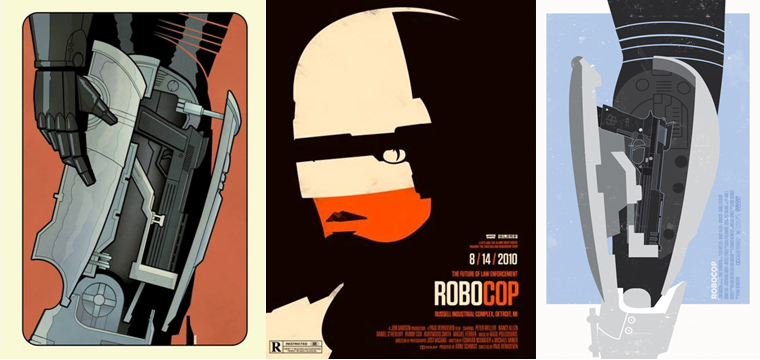
Auto 9 stał się rozpoznawalnym symbolem filmu, tak jak hełm noszony przez głównego bohatera, wypowiadana przez niego kwestia "Żywy lub martwy i tak pójdziesz ze mną" czy kowbojska sztuczka z obrotem broni na palcu. 

The Auto 9 have become a recognizable symbol of the movie, just like the helmet carried by the main protagonist, the phrase „Dead or alive, you’re coming with me” or the cowboy trick with the gun twirl.


Pistolet jako symbol produkcji został wykorzystany na kilku plakatach, zaprojektowanych przez fanów filmu. 

The handgun as the movie's symbol was used in a couple of posters, designed by fans.

 
Druga stworzona na potrzeby filmu broń to działku szturmowe Cobra, które pojawia się pod koniec i które banda Clarence’a Boddickera otrzymuje za wojskowych magazynów OCP, by zabić RoboCopa. To nic innego jak karabin wyborowy Barrett M82kal. .50BMG z gigantycznym plastikowym celownikiem (z którego, de facto, nikt nie korzysta).

The second weapon, created for the purpose of the movie, is a Cobra assault cannon that appears at the end of the film and that Clarence Boddicker’s gang gets from the mililtary magazines of OCP to kill RoboCop. It is nothing but a .50BMG Barrett M82 sniper rifle with a huge plastic scope (which actually remains unused).


Chłopaki w ramach rozgrzewki urządzają sobie strzelnicę na ulicach starego Detroit, rozwalając samochody (w tym nowiutki SUX 6000), hydranty i sklepowe witryny. Sam Boddicker chyba najlepiej oddaje ducha tej broni w kilku zaledwie słowach.

Just to warm up, the guys turn a street of the old Detroit into a shooting range, destroying cars (among them - the brand new SUX 6000), hydrants and shop windows. Boddicker’s words accurately express what the gun really is.


W filmie broń wystrzeliwuje pociski zapalające z ładunkiem wybuchowym, ale przy stosunkowo słabym odrzucie. Z broni można strzelać trzymając ją jednorącz, co widać w scenie finałowego pojedynku bandziorów Boddickera z RoboCopem w walcowni stali (tym samym historia zatacza koło - jest to to samo miejsce, w którym na początku filmu gang zastrzelił Alexa Murphy'ego).

In the movie, the gun fires an explosive incendiary rounds, but with a relatively small recoil. The weapon can be used while held in one hand what is visible in the final fight scene between the Boddicker’s gang and RoboCop in the steel-mill (thus, the story goes back to where it started – it’s the same place, where – at the beginnng of the movie, the gang executed Alex Murphy).


Użytek z działka robi partnerka Murphy'ego/RoboCopa - Anne Lewis (Nancy Allen), która rozwala z niego Leona Nasha (Ray Wise) - ostaniego z ludzi Boddickera, jak i sam tytułowy bohater – Robo korzysta ze zdobyczy technologii OCP, by zlikwidować robota policyjnego ED-209. Film zaś zamyka piękna "kowbojska" akcja z Auto 9.

The gun is used by Alex Murphy’s/RoboCop’s partner – Anne Lewis (Nancy Allen) who blows up Leon Nash (Ray Wise) – the last of Boddicker’s men, and by the main character – Robo uses the OCP technology to get rid of the ED-209 enforcement droid. The film ends with a beautiful "cowboy" action with the Auto 9. 


Pistoletu Auto 9 ani działka Cobra nie zobaczymy w nowej wersji „RoboCopa” (2014, reż. Jose Padilha). Ja jej nie oglądałem i nie wiem, kiedy obejrzę. Jakoś nie mogę się przekonać do uwspółcześnionej wizji – to zupełnie inna historia. Pozwólcie więc, że wpis zakończę komiksem (nie moim! – ja w wieku 12-13 lat nie umiałem tak rysować ani nie znałem tak angielskiego), w którym oczywiście również pojawia się Auto 9. 

You won’t see the Auto 9 pistol and the Cobra assault cannon in the new „RoboCop” (2014, directedy by Jose Padilha). I haven’t seen this movie and I don’t know when I will watch it. I just don’t feel convinced about the modern vision – it’s a totally different story. So just let me finish the post with a comic book (not mine – neither could I draw like this nor speak English when I was 12-13), where you can obviously see the Auto 9 too.


środa, 9 lipca 2014

Oko w oko / Straight in the eye

Jedną z najbardziej charakterystycznych postaci w "Szeregowcu Ryanie" (1998) jest nie sam tytułowy bohater szeregowy James Francis Ryan (Matt Damon) z Payton, w stanie Iowa, czy kapitan John Miller (Tom Hanks), a szeregowy Eugene Jackson (Barry Pepper) - cytujący Biblię strzelec wyborowy, uzbrojony z karabin Springfielda M1903 kal. .30-06 (wyposażony w lunetę M84). 

One of the most recognizable characters in „Saving Private Ryan” (1998) is not even the title character James Francis Ryan from Payton, Iowa (Matt Damon) or Captain John Miller (Tom Hanks), but Private Eugene Jackson (Barry Pepper) – a Bible-quoting sharpshooter, armed with a .30-06 Springfield M1903 sniper rifle (with a M84 scope).


Strzelecki kunszt Jacksona poznajemy już na początku filmu, kiedy celnym trafieniem zdejmuje obsługę MG-42 i rozwala worki z piaskiem tworzące jedno z gniazd kaemów na szczycie. Pamiętna jest również końcowa bitwa o Ramelle, kiedy Jackson razem z jednym ze spadochroniarzy ze 101 DPD zajmuje pozycje na kościelnej wieży, skąd likwiduje kolejnych żołdaków z Waffen-SS. Póki nie dosięga go pocisk z działa szturmowego Sav m/43. 

We can see Jackson’s shooting skills as he takes down a MG-42 squad and destroys sandbags of a machinegun nest on the cliff. Also, a memorable scene is the one where Jackson, together with one of the paratroopers of 101st Airborne, takes a position on the church tower and uses it as his post to fire at storming waves of Waffen-SS grunts. Until a shell from a Sav m/43 assault gun kills him. 


Skupimy się jednak na innej scenie. Oddział kpt. Millera wchodzi do miasteczka Neuville, gdzie jeden z żołnierzy, szer. Adrien Caparzo (Vin Diesel) pada ofiarą snajpera na kościelnej wieży (wciela się w niego kaskader, Leos Stransky). Rana od kuli wystrzelonej z karabinu Mauser Karabinek K98k kal. 7.92x57mm (z lunetą Zeiss ZF42) okazuje się być śmiertelna - "Carpy" wykrwawia się w ciągu kilkudziesięciu sekund, a jego koledzy nie są w stanie mu pomóc - Niemiec dalej poluje. I tu przychodzi czas na szer. Jacksona.

However, let’s focus on another scene. Capt. Miller’s squad enters Neuville, where one of his soldiers, Pvt. Adrien Caparzo (Vin Diesel) falls victim to a German sniper (played by a stunt, Leos Stransky) on a church tower. A wound caused by the bullet fired from the 7.92x57mm Mauser Karabiner K98k rifle (with a Zeiss ZF42) turns to be lethal – “Carpy” bleeds out after a while, and his friends are unable to help him – the German keeps on hunting. And that’s the time for Jackson.  


Nasz bohater zajmuje dogodną pozycję za kupą gruzu i czeka na odpowiedni moment, co przez chwilę obserwujemy oczami niemieckiego strzela wyborowego. Przez chwilę, bo gdy tylko wykrywa on Jacksona, ostatnią rzeczą, którą widzi jest wystrzał z karabinu Amerykanina. Kula rozbija lunetę i trafia w oko, zabijając Niemca. Strzał idealny. I co ciekawe, z tego, co podaje sproe.com (Saving Private Ryan On-Line Encyclopedia), scenę trafienia nakręcono za pierwszym razem i nie wykorzystano przy niej żadnych tricków komputerowych. 

Our hero takes a comfortable position behind a pile of rubble and waits for the right moment which we can actually observe for a moment through the eyes of the German sniper. For a moment, because the moment he spots Jackson, the last thing he sees is the shot fired from the American’s rifle. The bullet crushes the scope and hits the eye, killing the German instantly. A perfect shot. What is interesting, as stated on sproe.com (Saving Private Ryan On-Line Encylopedia), the scene was made during one shot and not special computer effects were used.


Scena nie jest jednak przypadkowym wyborem scenarzystów, ale hołdem złożonym Carlosowi Hathcockowi (1942-1999) - snajperowi Korpusu Piechoty Morskiej USA, który w czasie wojny w Wietnamie zasłynął także z walki przeciw snajperom Viet-Congu (z działań kontrsnajperskich) i strzałów w celowniki wroga. 

The scene is not an accidental choice of scritpt-writers, but a tribune to Carlos Hathcock (1942-1999) – a USMC sniper, who – during the Vietnam war, was famous for his fight against Viet-Cong snipers and shooting through the enemy’s scopes.


Armia Północnego Wietnamu (NVA) i Viet-Cong nazywały Hathcocka „Białym Piórem” („White Feather Sniper” – wiet. Lông Trắng du Kich) od pióra, które Amerykanin nosił w swoim kapeluszu. APW wyznaczyła za jego głowę 30.000 dolarów i wysyłała przeciw niemu kolejnych snajperów – bezskutecznie. Hathcock może się pochwalić 93 potwierdzonymi trafieniami, choć sam jednocześnie twierdzi, że w sumie zlikwidował ponad 300 żołnierzy wroga. Używał karabinów 7.62x51mm M14 oraz Winchester Model 70 kal. 30-06 z lunetą Unertl, a do obrony bezpośredniej – pistoletu .45 Colt M1911A1.  

The North Vietnamese Army (NVA) and Viet-Cong called Hathcock „White Feather” (Lông Trắng du Kich) due to a white feather he had in his hat. The NVA placed a bounty of $30,000 on his life and kept sending sniper to hunt him down, but without any effect. Hathcock had 93 confirmed kills, but he himself stated that he eliminated over 300 enemy soldiers. He used a 7.62x51mm M14 and a .30-06 Winchester Model 70 rifle with an Unertl scope, and for defense in CQB – a .45 Colt M1911A1 pistol.

 
Scena przedstawiona w „Szeregowcu Ryanie” faktycznie miała miejsce – w wietnamskiej dżungli, w okolicach Wzgórza nr 55 Na Hathcocka i jego obserwatora – Johna Rolanda Burke’a, polował snajper o pseudonimie „Kobra”, który zdążył już ukąsić śmiertelnie kilku Marines. W trakcie obserwacji terenu, Hathcock zauważył błysk światła w koronie drzew – wymierzył szybko i strzelił dokładnie w to miejsce. Po dotarciu do stanowiska, znalazł karabin przeciwnika z rozbitymi szkłami lunety, samego strzelca zaś z dziurą zamiast oka. Hathcock zdał sobie wówczas sprawę, że tak naprawdę przez ułamek sekundy dwaj strzelcy – tak jak w „Szeregowcu Ryanie” patrzyli na siebie przez lunety swoich karabinów, mimo odległości stanęli oko w oko. I gdyby Hathcock zawahał się choć przez ułamek sekundy, sam dołączyłby do ofiar „Kobry” lub dwaj strzelcy zastrzeliliby siebie nawzajem. 

The scene presented in „Saving Private Ryan” actually happened – in a Vietnamese jungle, near the Hill 55. A sniper nicknamed “Cobra” was hunting for Hathcock and his spotter – John Roland Burke, and he already lethally bit several Marines. During the observation of the area, Hathcock saw a flash of light in the woods – he aimed quickly and fired a shot directly at it. When he reached the position, he found a rifle with a shattered glass of the scope and the shooter with a hole instead of an eye. Hathcock realized that for a moment both snipers – just like in “Saving…” were looking at each other through the scopes of their rifles – straight in the eye. And if Hathcock had hesitated for a second, he would have joined other victims of “Cobra” or the two snipers would have killed each other.


Być może nawiązanie do historii Hathcocka nie znalazła się przypadkowo. W końcu doradcą przy filmie był Dale Dye, Kapitan USMC w stanie spoczynku. W „Szeregowcu…” możemy go zobaczyć w roli pułkownika z Departamentu Wojny. A to tylko jedna z wielu ról… i temat na osobny wpis. 

Perhaps, a reference to Hathcock’s story was not an accidental one. A military advisor was Dale Dye, a retired USMC Captain. In “Saving…” we can see him in the role of a colonel from the War Department. And it’s just one of many roles… and a story for a separate blog-post.