
Bartek Bera –
tegoroczny zdobywca Buzdygana Internautów, fotograf uwieczniający piękno
śmigłowców i samolotów, niejednokrotnie też i sił specjalnych. Miłośnik
lotnictwa i broni automatycznej, który bez końca może oglądać „Gorączkę”
Michaela Manna, zwykle strzelający foty innym – dziś sam znalazł się w ogniu…
pytań. A odpowiedział celnie i – co ważniejsze –
ciekawie.
Bartek Bera – this
year’s winner of Internauts' Buzdygan Prize, a photographer that captures the
beauty of choppers and aircrafts, repeatedly of the special forces. An
enthusiast of aviation and automatic weapons, who can watch Michael Mann’s
“Heat” over and over again, usually shooting pictures of others, today found
himself in the cross-fire of… questions. And he returned it with accurate and –
what is more important – interesting answers.
 |
| Z ukochanym HK416 - w trakcie sesji z GROM-em. With his beloved HK416 - during the session with GROM. |
Pewnie zadawano Panu
to pytanie wiele razy, ale dlaczego fotografia i dlaczego właśnie wojskowa? Czy
ma Pan także inne pasje czy zainteresowania, które wspierają Pana pracę?
I’m sure this you’ve
asked this question many times, but I’ve got to ask it too: why photography and
why the military photography? Do you have any other passions that support your
work?
Zainteresowanie wojskiem, a lotnictwem szczególnie, istniało u mnie od zawsze. Często spędzałem wakacje na terenach, gdzie aktywność lotnicza była spora (Nowy Glinnik – 66. Lotniczy Pułk Szkolny, Piła – 6 Pułk Lotnictwa Myśliwsko-Bombowego) i ewidentnie wyryło się to jakoś w mojej świadomości. Potem, w czasach liceum i pierwszych lat studiów, miałem odrobinę przerwy, ale wraz z zakupem pierwszego aparatu cyfrowego dawna pasja odżyła. Oczywiście, nie od razu, potrzeba było sporo wysiłku, by dotrzeć tu gdzie jestem, ale uczciwie trzeba powiedzieć, że był to bardzo przyjemny wysiłek. Chciałem też podkreślić, że nie czuję się żadnym znawcą tematyki militarnej, choć oczywiście nie ograniczam się tylko do beznamiętnego naciskania spustu migawki. Staram się systematycznie poszerzać swoją wiedzę na tematy, z którymi obcuję za pośrednictwem obiektywu, ale dalej uważam, że moja wiedza nie jest wystarczająco głęboka.


Wiem, że jest Pan fanem filmu Michaela Manna "Gorączka", w szczególności zaś sceny pojedynku grupy Neila McCauleya (Robert De Niro) z L.A.P.D. Co czyni tę scenę tak wyjątkową?
Lubię wszelakie skrócone wersje M16 – tu mamy głównie pięknego Colta 733 – choć przyznaje, że początkowo myślałem, że to Colt Commando. Pamiętam, jak w Afganistanie rozmawiałem z jednym obytym w boju kapitanem US Army – wskazywał właśnie „Heat” oraz „Ronin” (również na mojej liście „naj”) jako filmy w których strzelaniny wyglądają najbardziej realistycznie. Tylko skąd pomysł na tego Galila dla Cherito? :)
I like all the shortened versions of the M16 – here we’ve got mostly the beautiful Colt 733, although I have to admit that first I thought I was a Colt Commando. I remember that in Afghanistan I talked to a US Army captain hardened in battle – he mentioned “Heat” and “Ronin” (also in my top movie list) as the movies where the shootouts are the most realistic ones. Still though, why the hell did they give a Galil to Cherito? :)
Świat filmu rządzi się swoimi prawami, z jednej strony mamy uproszczenia, z drugiej wyolbrzymienia, przesadę. Jakie najbardziej absurdalne sceny przychodzą Panu do głowy, gdy myśli Pan o prezentacji broni w filmie?
W kategoriach czysto rozrywkowych nie wiem, czy nie wole tego dawnego „Snajpera” z Tomem Berengerem używającym M40 i Billym Zanem strzelającym z SR9 (choć byłem w młodości święcie przekonany, że to jakaś wersja PSG-1).
When I think of such movies in t terms of an entertainment, I guess I’d rather choose the old “Sniper” featuring Tom Berenger who uses a M40 and Billy Zane with a SR9 (which I took for a version of the PSG-1 when I was younger).

Lubię „Zero Dark Thirty” (polski tytuł - "Wróg Numer Jeden" - jest okropny) – nie jest to typowy film wojenny, ale sceny „afgańsko - pakistańskie” mają moim zdaniem dobry klimat. No i fantastycznie jest pokazany „szpej” – od HK416 z 10-calową lufą po panoramiczne gogle noktowizyjne GPNVG-18, które stały się już niemal symbolem tego filmu. Mało znany jest w Polsce „Generation Kill” – a to chyba najlepszy serial opowiadający o konfliktach „wojny z terrorem”.
Unfortunately, I have to tell you they are poor. The already mentioned „Mission: Afghanistan” was truly embarrassing at times, in my opinion. I hope that “Karbala” that shall soon be available, will be a lot better. In case of the police TV series, I only acknowledge two – “Pitbull” and “The Cop”. Both of them are assessed very high by professionals in terms of realism. Unfortunately the gun scenes, in my opinion, are poorly made, especially in “Pitbull”. What is visible is the actors’ lack of experience with firearms (the scene in the city with a Onyks assault rifle and a Glauberyt submachine gun looks really poor - the same goes with the shootout scene in Magdalenka). “The Cop” – probably thanks to the directors, is a bit better here, especially in case of the shootout with Karbowiak’s crew. Also – the teams of SPAT (Independent Anti-Terrorism Subunit / BOA (Anti-Terrorist Operations Bureau) look a lot better than those from the times of Commissioner Halski. The 1990s attempts in terms of realism are rather failed – “Extradition” or “Demons of War”, for example.
I guess
these would be aviation movies: “Top Gun”, “Iron Eagle”, “Battle of Britain”.
Although the first two totally lack the realism, they show the exceptional
beauty of aviation and to some extent assured me that this would be my hobby. As
for the picture that changed my life – I guess it was the one I finally have
not seen in the report about the “Independent Air Assault Group” in one of Polish aviation magazines. I decided
then I should do it better. My stay in Afghanistan, although rather short, surely
changed my life and will remain deep in my memory as the most exciting
experience.


Jako uznany fotograf, współpracujący z siłami zbrojnymi i obcujący ich wyposażeniem, chwyta Pan często uzbrojenie - od indywidualnego oddziałów specjalnych po myśliwce i helikoptery. Jaki jest sekret oddania ich mocy, piękna, grozy? Kiedy Pan wie, że to jest ten moment naciśnięcia spustu migawki?
I
think that the secret is to work with them as often as you can. One needs to
learn features of individual helicopters, planes or firearms: to know in which
situations or frames they present at their best. If we’re talking about a
“conscious photography” and that’s what I am trying to do, the frames should be
thought-over and planned in advance which, of course, is not always possible.


I haven’t had such a chance yet, but one of my friends from a re-enactment
group of JWK encourages me to take part in a photo-session. In my opinion the
potential of these groups in indisputable. Nowadays there is no production of
historical character without re-enactment groups. It is a very positive trend
and thanks to that film crews have a guaranteed high level of realism in terms
of weapons, uniforms and very often – behavior.


Czego nie odda film, co uchwyci zdjęcie? I na odwrót? I czy jest coś, co pozostanie poza zasięgiem fotografów czy twórców filmowych?
Zainteresowanie wojskiem, a lotnictwem szczególnie, istniało u mnie od zawsze. Często spędzałem wakacje na terenach, gdzie aktywność lotnicza była spora (Nowy Glinnik – 66. Lotniczy Pułk Szkolny, Piła – 6 Pułk Lotnictwa Myśliwsko-Bombowego) i ewidentnie wyryło się to jakoś w mojej świadomości. Potem, w czasach liceum i pierwszych lat studiów, miałem odrobinę przerwy, ale wraz z zakupem pierwszego aparatu cyfrowego dawna pasja odżyła. Oczywiście, nie od razu, potrzeba było sporo wysiłku, by dotrzeć tu gdzie jestem, ale uczciwie trzeba powiedzieć, że był to bardzo przyjemny wysiłek. Chciałem też podkreślić, że nie czuję się żadnym znawcą tematyki militarnej, choć oczywiście nie ograniczam się tylko do beznamiętnego naciskania spustu migawki. Staram się systematycznie poszerzać swoją wiedzę na tematy, z którymi obcuję za pośrednictwem obiektywu, ale dalej uważam, że moja wiedza nie jest wystarczająco głęboka.
I’ve been interested in the military, and in
military aviation in particular, since I can remember. I used to spend summer
holidays in places where aviation was a common thing (e.g. in Nowy Glinnik – 66th
Aviation Training Regiment, in Piła – 6th Fighter-Bombers Regiment) and
surely it stamped my consciousness in a way. Then, during the secondary school
and first years of university, I had a break – but when I bought my first
digital camera – my passion was reborn and returned. Of course, not at once –
it took me some effort to get where I am now, but, honestly, it was a very
pleasant effort. I would like to underline here the fact that I am not military
expert, although I surely do more than just click the shutter. I’m trying to
develop my knowledge systematically in the field I am in touch with via my
camera, but again this knowledge is not deep enough.
Wiem, że jest Pan fanem filmu Michaela Manna "Gorączka", w szczególności zaś sceny pojedynku grupy Neila McCauleya (Robert De Niro) z L.A.P.D. Co czyni tę scenę tak wyjątkową?
I know that you’re fan of Michael Mann’s „Heat”
and in particular: the scene of a shootout between Neil McCauley’s (Robert De
Niro) gang and L.A.P.D. What
makes this scene so special?
Tak, "Gorączka" to zdecydowanie mój ukochany film. Pamiętam,
jak wcisnął mnie w fotel w kinie, gdy widziałem go po raz pierwszy w 1995 roku
w mojej rodzinnej Częstochowie. Z niewiadomych w sumie przyczyn zawsze
uwielbiałem sceny z bronią – szczególnie maszynową, więc już zwiastuny mnie
przekonały, że na film iść muszę. Oczywiście, nie zawiodłem się. Scena wyjścia z
banku jest w mojej opinii najlepszą strzelaniną w historii. Uwielbiam jej
realizm, dbałość o detale i warstwę dźwiękową. Podoba mi się kwestia wymiany
magazynków i ich obecności (w ułamkach sekund jeszcze w banku widać jak ekipa McCauleya
ma kamizelki „taktyczne” z dodatkowymi magazynkami – coś, co w innych filmach
praktycznie nie występowało). Oczywiście jest też legendarny już niemal moment
gdy, ukryty za samochodem Shiherlis przepina magazynek – ponoć w Marines
pokazują go rekrutom jako wzorzec szybkości przeładowania.
Yes, „Heat” is definitely my favorite movie. I
remember that it kept me on the edge of my seat when I first saw it in 1995 in the cinema in
my family city of Czestochowa. For reasons still unknown to me, I have always
liked the scenes with firearms – especially the automatic ones, so the trailers
already convinced me to go to the cinema. And I got what I wanted, I was fully
satisfied. The scene presenting the escape from the bank is one of the best in
history, in my opinion. I love the realism, details and the sounds. I like the
mag-changes and the fact it was actually presented (still in the bank one can
see that McCauley’s gang have “tactical” vests with extra magazines – something
that had not been seen before in the movies in those times). Of course, there
is a legendary moment of mag-change performed by Shiherlis hidden behind the
cars – I heard that in the US Marines it is shown to the recruits as the example of speed reloading to follow.
Lubię wszelakie skrócone wersje M16 – tu mamy głównie pięknego Colta 733 – choć przyznaje, że początkowo myślałem, że to Colt Commando. Pamiętam, jak w Afganistanie rozmawiałem z jednym obytym w boju kapitanem US Army – wskazywał właśnie „Heat” oraz „Ronin” (również na mojej liście „naj”) jako filmy w których strzelaniny wyglądają najbardziej realistycznie. Tylko skąd pomysł na tego Galila dla Cherito? :)
I like all the shortened versions of the M16 – here we’ve got mostly the beautiful Colt 733, although I have to admit that first I thought I was a Colt Commando. I remember that in Afghanistan I talked to a US Army captain hardened in battle – he mentioned “Heat” and “Ronin” (also in my top movie list) as the movies where the shootouts are the most realistic ones. Still though, why the hell did they give a Galil to Cherito? :)
Świat filmu rządzi się swoimi prawami, z jednej strony mamy uproszczenia, z drugiej wyolbrzymienia, przesadę. Jakie najbardziej absurdalne sceny przychodzą Panu do głowy, gdy myśli Pan o prezentacji broni w filmie?
The movie world is
governed with its own rules: on one hand there are simplifications, on
the other: overstatements and exaggerations. Do you recall the most absurd
scenes in terms of presentation of the firearms in the movies?
Niestety, takich jest zdecydowana większość. Brak dbałości o szczegóły,
amunicja w trybie „unlimited” itd., niefachowe obchodzenie się z bronią. Nie sądzę,
bym był na tyle kompetentny, aby wskazać największe absurdy, ale z ostatnich
kilku lat przychodzi mi do głowy choćby fantazyjne przepinanie magazynków w
„Misji Afganistan” – znane może graczom „Call of Duty”, ale raczej nie
żołnierzom. Bardzo zawiodłem się też finałową akcją filmu „Furia” – takiego
nagromadzenia absurdów chyba ze świecą szukać w „nowym kinie wojennym”. Szkoda,
bo zapowiadało się bardzo dobrze – rewelacyjna, porywająca wręcz scena
pojedynku Shermanów i Tygrysa (po raz pierwszy w historii oryginalnego) czy
mały smaczek w postaci Brada Pitta strzelającego do uciekającego Niemca ze
Stg44 (nieczęsto pojawiająca się w oryginale broń w filmie – patrz: Roman
Kłosowski strzelający z AK udającego Sturmgewehra w odcinku „Pierścienie”
serialu „Czterej Pancerni i Pies”).
Unfortunately, they are seen in majority. A lack of care for details, ammo in unlimited mode, unprofessional weapon handling. I guess I am not competent enough to point out the biggest absurd scenes, but during the last few years I can recall fancy mag-change in “Mission: Afghanistan” – known to players of “Call of Duty”, but certainly not to soldiers. I was truly disappointed by the final scene of “Fury” – I haven’t seen such a load of absurd in the “new war cinema”. It’s a great shame, because the movie looked pretty good thanks to a fantastic, thrilling scene of a duel between Shermans and a Tiger (the original one – for the first time in the cinema) and a small tasty detail: Brad Pitt shooting an escaping German with a Stg44 (which does not appear often in the screen – vide: Roman Kłosowski shooting an AK that pretends to be a Sturmgewehr in episode “Rings” in “Four Tankers and a Dog”).
Unfortunately, they are seen in majority. A lack of care for details, ammo in unlimited mode, unprofessional weapon handling. I guess I am not competent enough to point out the biggest absurd scenes, but during the last few years I can recall fancy mag-change in “Mission: Afghanistan” – known to players of “Call of Duty”, but certainly not to soldiers. I was truly disappointed by the final scene of “Fury” – I haven’t seen such a load of absurd in the “new war cinema”. It’s a great shame, because the movie looked pretty good thanks to a fantastic, thrilling scene of a duel between Shermans and a Tiger (the original one – for the first time in the cinema) and a small tasty detail: Brad Pitt shooting an escaping German with a Stg44 (which does not appear often in the screen – vide: Roman Kłosowski shooting an AK that pretends to be a Sturmgewehr in episode “Rings” in “Four Tankers and a Dog”).
Gdyby miał Pan
wskazać film lub serial, najwierniej oddający realia pola walki i życia
żołnierzy, co by Pan wybrał?
If you had to point a film or a TV series that
conveys the realism of the battlefield and life of soldiers, what would you
choose?
Tu chyba nie będę oryginalny – bliźniacze „Szeregowiec Ryan”
i „Kompania Braci” – obie produkcje zmieniły oblicze kina wojennego. Całościowo
chyba „Band of Brothers” podoba mi się nawet bardziej ze względu na osoby
prawdziwych żołnierzy, o których opowiada serial.
I guess I won’t be very original here – twin motion pictures of „Saving Private Ryan” and „Band of Brothers” – both productions changed the war cinema. In general, the latter I like even more because of the characters based on real human beings the show tells the story about.

I guess I won’t be very original here – twin motion pictures of „Saving Private Ryan” and „Band of Brothers” – both productions changed the war cinema. In general, the latter I like even more because of the characters based on real human beings the show tells the story about.
Z filmów traktujących o współczesnych konfliktach cenię, oczywiście, „Helikopter w ogniu” – z wiadomych przyczyn, choć muszę ze wstydem
przyznać, iż na początku nie byłem nim jakoś szczególnie zachwycony. Podoba mi
się obraz uzależnienia od wojennej adrenaliny w „Hurt Lockerze” (choć pomijając
scenę strzelania z Barretta nie ma tam zbyt dużo epickiej akcji „karabinowej”),
a kompletnie nie przemawia do mnie niedawny „Snajper”, który w mojej ocenie
jest infantylny. Mam wrażenie, że jest on nadmiernie uproszczony i zdecydowanie nastawiony na widza amerykańskiego, co widać choćby w ostatnich scenach z pogrzebu. Zaś uzależnienie od wojny nie jest pokazane, w mojej opinii, w wiarygodny sposób - o wiele bardziej podobało mi się właśnie we wspomnianym "Hurt Lockerze", vide: scena z płatkami w sklepie - jest prawdziwie poruszająca.
Among the movies of modern conflicts I truly
value “Black Hawk Down” – due to obvious reasons, although I have to admit that
at first I was not particularly impressed by it. I like the way war-addiction
was presented in “Hurt Locker” (although – apart from the sniper scene with the
Barrett, there is not much of epic battle scenes with rifles or machine guns),
but I totally don’t get the recent “American Sniper” which seems to be infantile to me. I have an impression that it is simplified too much and definitely addressed to the American audience, which is clearly visible in the final scenes from the funeral. As for the war addiction, in my opinion, it is not shown in a reliable way - I liked the presentation of it much more in the mentioned "Hurt Locker", vide: the scene with the cereals in the store - it is truly moving.
W kategoriach czysto rozrywkowych nie wiem, czy nie wole tego dawnego „Snajpera” z Tomem Berengerem używającym M40 i Billym Zanem strzelającym z SR9 (choć byłem w młodości święcie przekonany, że to jakaś wersja PSG-1).
When I think of such movies in t terms of an entertainment, I guess I’d rather choose the old “Sniper” featuring Tom Berenger who uses a M40 and Billy Zane with a SR9 (which I took for a version of the PSG-1 when I was younger).
Lubię „Zero Dark Thirty” (polski tytuł - "Wróg Numer Jeden" - jest okropny) – nie jest to typowy film wojenny, ale sceny „afgańsko - pakistańskie” mają moim zdaniem dobry klimat. No i fantastycznie jest pokazany „szpej” – od HK416 z 10-calową lufą po panoramiczne gogle noktowizyjne GPNVG-18, które stały się już niemal symbolem tego filmu. Mało znany jest w Polsce „Generation Kill” – a to chyba najlepszy serial opowiadający o konfliktach „wojny z terrorem”.
I like “Zero Dark Thirty” (the Polish title - "Enemy Number One" - is
horrible) – it’s not a typical war movie, but “Afghan-Pakistani” scenes have
the right atmosphere, but the most fantastic thing is how the “army stuff” is
presented here: from the HK416 with a 10-inch barrel to PNVG-18 goggles with a
panoramic view that have almost become a symbol of this movie.“Generation Kill”, not so well-known in Poland,
is probably the best TV series describing
the “war of terror”.
Może nieco z innej beczki, ale w kategorii scen „strzelanych” bardzo lubię film, który w Polsce nie trafił nawet do kin – „Miasto złodziei" Bena Afflecka. Oczywiście, obraz ewidentnie nawiązuje do „Gorączki” i może dlatego tak mi się podoba. Wśród broni parę smaczków – mój ukochany HK416 czy AKMSU.
Może nieco z innej beczki, ale w kategorii scen „strzelanych” bardzo lubię film, który w Polsce nie trafił nawet do kin – „Miasto złodziei" Bena Afflecka. Oczywiście, obraz ewidentnie nawiązuje do „Gorączki” i może dlatego tak mi się podoba. Wśród broni parę smaczków – mój ukochany HK416 czy AKMSU.
Now,
from a completely different shelf, in the category shootout scenes I like a
film that in Poland was not even shown in cinemas – Ben Affleck’s “The Town”.
Of course, it refers to “Heat” and probably this is the reason I like to much.
And we’ve got a couple of relishes – my beloved HK416 and an AKMSU.
Jaka jest wg Pana podstawa dobrego filmu wojennego?
What’s
the foundation of a good war movie?
Realizm i mocne osadzenie w
historii. Bez tego dla mnie żaden film czy serial się nie obroni. Mimo
przyzwoitego klimatu, nie jestem w stanie oglądać „Czasu Honoru” - właśnie z powodu braku wyżej wymienionych
cech. „Szeregowiec Ryan”, jako protoplasta „nowego kina wojennego”, postawił
poprzeczkę bardzo wysoko i wszystko, co nie zbliża się poziomem do niego, jest - w mojej ocenie, kiepskie („Furia”). Bardzo razi mnie nadużywanie efektów
specjalnych, dlatego cieszę się, że - przykładowo: „Ślicznotka z Memphis” czy
„Bitwa o Anglię”, zostały nakręcone lata temu. Dziś zamiast prawdziwych B-17
czy hord Spitfire’ów mielibyśmy komputerowo generowane obrazy.
Realism and a solid base in the history. Without it, no movie or TV show
will defend itself. Despite a decent atmosphere, I cannot watch „Days of Honor”
– simply because it lacks the two mentioned elements. “Saving Private Ryan”, a
progenitor of „the new war cinema”, set the level of expectations really high
and everything that does not come even close to this level, is simply poor
(“Fury”). I get annoyed with the amount of special effects, that is why I am
glad that “Memphis Belle” or “Battle of Britain” were made years ago – today
instead of real B-17 bombers or hordes of Spitfire aircrafts we would have
computer-generated images.
Wspomniał Pan "Czas Honoru"... Jak w tej kwestii -
przedstawienia broni, realizmu, wyglądają polskie produkcje? Czego im brakuje?
W czym są mocne? Czy jest taka, która wyróżnia się realizmem przedstawienia pracy
z bronią czy funkcjonowanie służb mundurowych, policji, wojska itp?
You mentioned "Days of Honor"... How does – in terms of
presentation of firearms, realism – Polish productions look like? What do they
lack? What are their strengths? Is there a Polish production that is exemplary
in terms of presentation of weapon-handling or everyday work of law enforcement
officers or the military?
Z przykrością stwierdzam, że są słabe w tym temacie. Wspomniana już „Misja
Afganistan” była momentami wręcz żenująca w mojej ocenie. Liczę, że zbliżający
się film „Karbala” będzie na tym polu dużo lepszy. W kwestii seriali
policyjnych uznaję tylko dwa – „Pitbull” i „Glina”. Oba są oceniane przez
fachowców wysoko w kategorii realizmu. Niestety sceny z bronią wypadają, moim
zdaniem, kiepsko, szczególnie w „Pitbullu”. Widać brak obycia z bronią wśród
aktorów (akcja w mieście, gdy w użyciu są Onyks i Glauberyt, wygląda bardzo
kiepsko, podobnie strzelanina w Magdalence). „Glina” – pewnie ze względu na
osobę reżysera, prezentuje się tu lepiej, zwłaszcza jeśli chodzi o scenę strzelaniny
z ekipą Karbowiaka w pierwszej serii. Także ekipy SPAT (BOA?) wyglądają o niebo
lepiej niż te z czasów komisarza Halskiego. Próby z lat 90-tych w kwestii
realizmu są raczej nieudane – „Ekstradycja” czy „Demony Wojny”.
Unfortunately, I have to tell you they are poor. The already mentioned „Mission: Afghanistan” was truly embarrassing at times, in my opinion. I hope that “Karbala” that shall soon be available, will be a lot better. In case of the police TV series, I only acknowledge two – “Pitbull” and “The Cop”. Both of them are assessed very high by professionals in terms of realism. Unfortunately the gun scenes, in my opinion, are poorly made, especially in “Pitbull”. What is visible is the actors’ lack of experience with firearms (the scene in the city with a Onyks assault rifle and a Glauberyt submachine gun looks really poor - the same goes with the shootout scene in Magdalenka). “The Cop” – probably thanks to the directors, is a bit better here, especially in case of the shootout with Karbowiak’s crew. Also – the teams of SPAT (Independent Anti-Terrorism Subunit / BOA (Anti-Terrorist Operations Bureau) look a lot better than those from the times of Commissioner Halski. The 1990s attempts in terms of realism are rather failed – “Extradition” or “Demons of War”, for example.
Chyba wolę już dawne polskie kino wojenne. W mojej ocenie sekwencja zamachu na Franza Kutschere z filmu „Zamach” jest jak na tamte czasy bardzo dobra. Ciągle czekam na porządny serial „partyzancki”. Scenariuszy nie trzeba pisać – życie już dawno temu je napisało – i to znacznie lepsze niż bzdurny „Czas Honoru”, który koloryzując historię, w moim przekonaniu, przyniósł więcej szkody niż pożytku. Niezłe sceny batalistyczne w całościowo nieznośnie infantylnym filmie „Miasto44” dają jakąś nadzieję.
I guess I prefer the old Polish war cinema – in my opinion, the scene
of the hit on Franz Kutchera from the movie “The Hit” (“Zamach”) is –
considering the times – very good. I am still wating for a good “partisan” TV
series. The script doesn’t have to be written – the life itself already wrote
it long time ago – and it is a lot better than the trivial “Days of Honor” that
embellished the history and caused, in my opinion, more harm than good. Pretty
good battle scenes in generally infantile “City 44” give a bit of hope.
Czy istnieje taki
film, który wywarł na Panu największe wrażenie, wpłynął znacząco na Pana życie,
postrzeganie świata? A może jest taka fotografia?
Is there a movie that
made the biggest impression on you, influence your life, perception of the
world? Or maybe it was a picture?
Myślę, że kilka filmów „lotniczych”: „Top Gun”, „Żelazny
Orzeł”, „Bitwa o Anglię”. Jakkolwiek dwa pierwsze z realizmem są na bakier, to
pokazywały niesamowite piękno lotnictwa i w jakimś stopniu mnie utwierdziły, że
to właśnie będzie moje hobby. Co do fotografii, która zmieniła moje życie to
myślę, że jest to ta, której nie zobaczyłem w reportażu o „Samodzielnej Grupy
Powietrzno-Szturmowej” PKW Afganistan w jednym z krajowych magazynów lotniczych.
Wtedy postanowiłem, że spróbuje zrobić to lepiej. Pobyt w Afganistanie, choć
krótki, z pewnością zmienił moje życie i wyrył się w mojej pamięci jako
najbardziej ekscytujące wydarzenie.
Jako uznany fotograf, współpracujący z siłami zbrojnymi i obcujący ich wyposażeniem, chwyta Pan często uzbrojenie - od indywidualnego oddziałów specjalnych po myśliwce i helikoptery. Jaki jest sekret oddania ich mocy, piękna, grozy? Kiedy Pan wie, że to jest ten moment naciśnięcia spustu migawki?
As a recognized photographer, co-operating with
military forces and working with their equipment on daily basis, you capture
weapons with your camera – individual of special forces along with aircrafts
and helicopters. What’s secret to convey its power, beauty, menace. When do you
know that it is the right time to click the shutter?
Myślę, że sekretem jest właśnie częste obcowanie z nimi.
Poszczególnych typów śmigłowców, samolotów czy broni trzeba się nauczyć, wiedzieć,
w jakich sytuacjach czy kadrach prezentują się najlepiej. Jeśli mówimy o
świadomym fotografowaniu, a takie staram się uprawiać, to kadry powinny być
przemyślane i z góry zaplanowane, co oczywiście nie zawsze jest możliwe.
Czy miał Pan okazję
współpracować z grupami rekonstrukcyjnymi? Czy polskie kino wykorzystuje
potencjał pasjonatów historii i militariów? Czy twórcy dostrzegają fakt, że
jest to przyszłość produkcji wojennych czy nadal ta współpraca jeszcze
raczkuje?
Have you had a chance
to work with re-enactment groups? Does Polish cinema use the full potential of
these enthusiasts of history and military? Do movie-makers see that this is
the future of war dramas or is it still
a beginning?
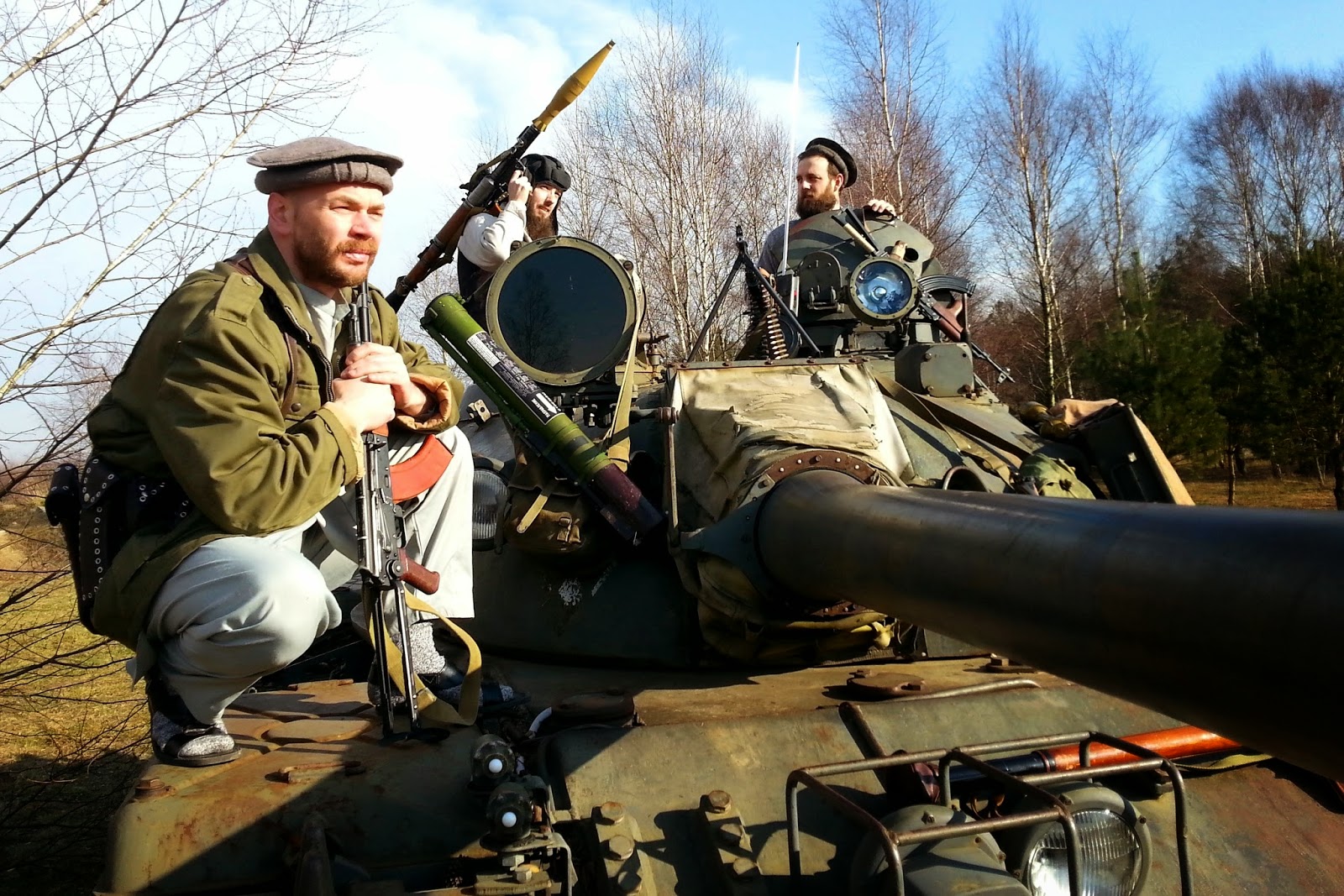
Jeszcze nie miałem ku temu okazji, choć jeden z kolegów, działający w ekipie odtwarzającej JWK, namawia mnie na sesję zdjęciową. Sądzę, że
potencjał takich grup jest niepodważalny. Nie ma obecnie
produkcji historycznej, gdzie ekipy rekonstrukcyjne by się nie pojawiały. To
bardzo pozytywny trend. Dzięki niemu filmowcy mają zagwarantowany wysoki poziom
realizmu broni, umundurowania, często także zachowania.
Czego nie odda film, co uchwyci zdjęcie? I na odwrót? I czy jest coś, co pozostanie poza zasięgiem fotografów czy twórców filmowych?
What cannot be
reflected in a movie, but will be reflected in a picture? Or the other way
round? Is there anything that will remain out of reach of photographers or
movie-makers?
Zdjęcie nie odda głosu, co w przypadku branży, którą się
zajmuję, jest często bardzo ważne – wie to każdy, kto stał naprzeciwko startującego
Mi-24 czy MiGa-29 lub też obok strzelającego moździerza M-98. Niestety, w
dzisiejszych konsumpcyjnych czasach, obrazy ruchome zawsze znajdą większe
audytorium niż najlepsze nawet zdjęcia.
A picture will not reflect the sound, which in
case of the field I’m in, is often very important. It is a well known fact to
everyone who stood in front of a Mi-24 or a MIG-29 ready to start, or a
shooting M-98 mortar. Unfortunately, in our commercialized times motion
pictures will always find much bigger audience than the best photographs.


Dziękuję za rozmowę. Proszę dalej "strzelać" tak niezwykłe zdjęcia! Życzę niezapomnianych ujeć, możliwości rozwoju pasji w trybie "unlimited" i jak najwięcej filmów w stylu "Gorączki"!
Thank you for the interview. Keep shooting great photos like you shoot now. I wish you a lot of unforgetable shots, opportunities to develop your passion in "unlimited" mode, and as many "Heat"-style movies as possible!
Thank you for the interview. Keep shooting great photos like you shoot now. I wish you a lot of unforgetable shots, opportunities to develop your passion in "unlimited" mode, and as many "Heat"-style movies as possible!


.jpg)




.jpg)


